
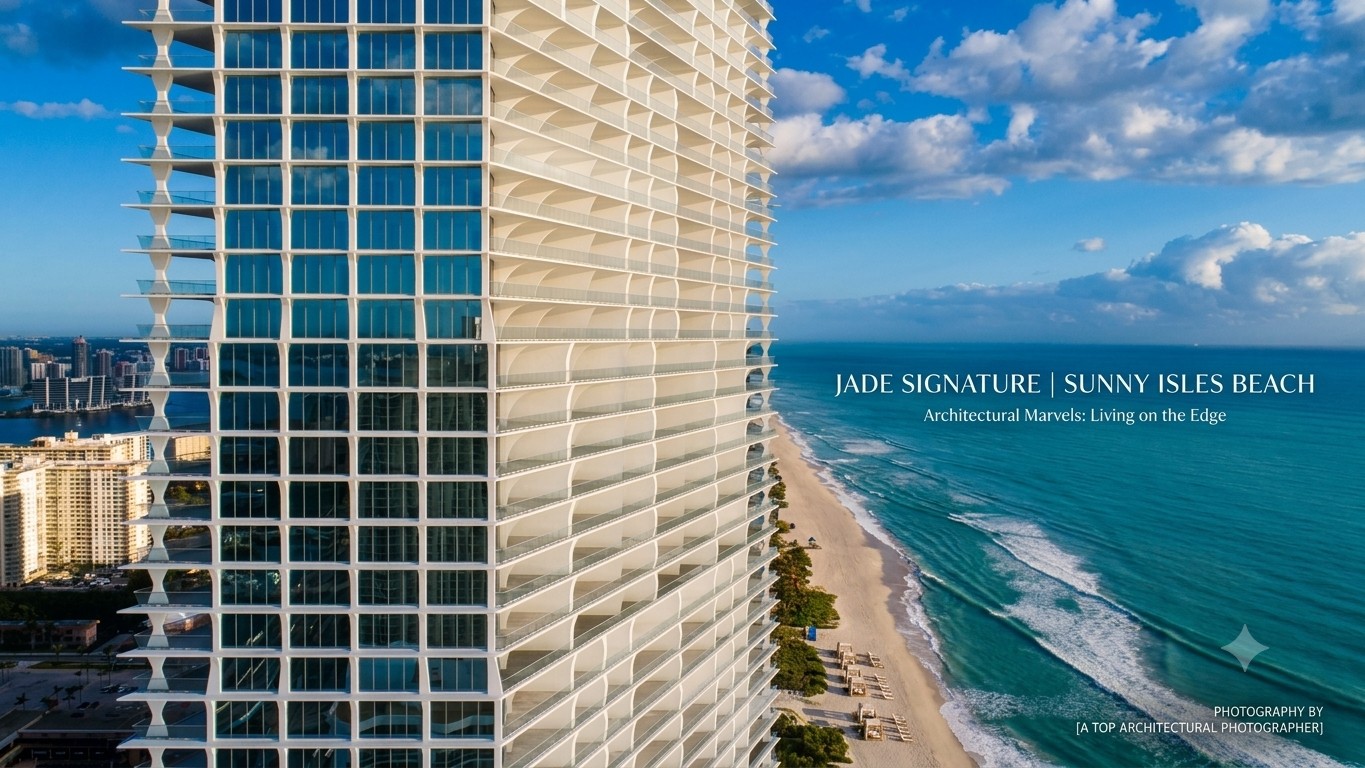
Most luxury condominiums are designed by architects whose names mean little outside the real estate industry — competent, experienced firms who deliver attractive buildings without claiming a place in architectural history. Jade Signature is a fundamentally different proposition. It is one of the very few residential towers in the United States designed by a Pritzker Prize-winning architecture firm — and that distinction shapes everything about the building, from its physical form to its long-term value as an asset.
This is the story of why that matters — and why the Herzog & de Meuron name attached to 16901 Collins Avenue is not a marketing flourish, but a genuine and rare credential in the world of residential real estate.
Who Are Herzog & de Meuron?
Herzog & de Meuron is a Swiss architecture firm founded in 1978 by Jacques Herzog and Pierre de Meuron in Basel, Switzerland. Over more than four decades, the firm has become one of the most consequential forces in contemporary architecture — responsible for some of the most recognized and culturally significant buildings constructed anywhere in the world during that period.
In 2001, Herzog & de Meuron received the Pritzker Architecture Prize — widely regarded as architecture’s highest honor, often described as the field’s equivalent of the Nobel Prize. The Pritzker Prize is awarded to a living architect (or architects, in the case of partnerships) whose built work demonstrates “a combination of those qualities of talent, vision, and commitment which have produced consistent and significant contributions to humanity and the built environment.” Since its founding in 1979, the prize has been awarded to fewer than 50 architects or firms — Herzog & de Meuron’s selection places them in an extraordinarily small group.
Notable Herzog & de Meuron Projects
The firm’s portfolio includes some of the most recognized buildings of the past three decades:
- Tate Modern, London — the transformation of the former Bankside Power Station into one of the world’s most visited contemporary art museums
- Beijing National Stadium (“Bird’s Nest”) — the iconic stadium built for the 2008 Beijing Summer Olympics, among the most photographed structures of the modern Olympic era
- 56 Leonard Street, New York — a celebrated residential tower in Tribeca known for its irregular, cantilevered massing, often nicknamed the “Jenga Building”
- Elbphilharmonie, Hamburg — a concert hall built atop a historic warehouse on Hamburg’s waterfront, now one of Germany’s most significant cultural landmarks
- 1111 Lincoln Road, Miami Beach — a mixed-use parking structure and retail building that redefined what a parking garage could be as architecture, frequently cited among the most innovative structures in Miami
- VitraHaus, Germany — a showroom building for furniture company Vitra, recognized for its distinctive stacked-house form
What unites this body of work is not a single signature style — Herzog & de Meuron are known specifically for resisting a repeatable formula, instead developing a distinct architectural response to each site, material, and cultural context. This is, in itself, part of why a Herzog & de Meuron commission is considered so significant: each building is a unique solution rather than a variation on an established template.
Why a Pritzker Firm Designing a Condo Building Is Rare
To understand why Jade Signature’s architectural pedigree matters, it helps to understand how unusual the situation actually is.
Pritzker Prize-winning architects overwhelmingly direct their practices toward museums, cultural institutions, civic buildings, corporate headquarters, and occasionally single-family residences for the ultra-wealthy. Multi-unit residential condominium towers are, with few exceptions, simply not where these firms typically work. The economics, design constraints, and developer relationships required to bring a Pritzker-tier architect into a commercial residential project are difficult to align, which is exactly why so few buildings like Jade Signature exist anywhere in the world.
Jade Signature represents one of Herzog & de Meuron’s first major residential commissions in the United States. The opportunity for Fortune International Group and Château Group, the building’s developers, to secure this specific firm for a Sunny Isles Beach condominium tower was a genuinely rare alignment of ambition, budget, and architectural interest — not something easily replicated by another developer simply by writing a larger check.
For buyers, this rarity is not an abstract cultural point — it has a direct bearing on the asset’s long-term position in the market. There are a finite, very small number of Pritzker-designed residential buildings in the world, and Jade Signature is one of them. That scarcity does not change, regardless of market cycles.
The Design Philosophy Behind Jade Signature
Herzog & de Meuron’s approach to Jade Signature reflects the firm’s broader design philosophy: a deep, site-specific response rather than an imported formula.
Responding to water. The building’s most distinctive feature — its cantilevered, horizontally articulated terraces — was conceived as an architectural response to the movement of water itself. Rather than the conventional vertical glass tower that dominates most of the Sunny Isles Beach skyline, Jade Signature’s massing reads as a series of horizontal layers, evoking waves or sediment layers along a shoreline. The building does not simply sit on the beach; its form is meant to be in conversation with it.
Light and transparency. The extensive use of glass throughout the building is calibrated specifically for Sunny Isles Beach’s intense, direct sunlight — a different design problem than the diffuse light conditions Herzog & de Meuron more typically encounters in their European and Northeast Asian commissions. The result is a building that manages heat and glare while still maximizing the transparency and light the oceanfront site affords.
Floating form. From certain vantage points along Collins Avenue, Jade Signature’s lower floors recede visually while the upper structure appears to project outward and upward — creating an impression that the building is lighter than its physical mass, almost floating above its site. This is a recurring theme in Herzog & de Meuron’s work: using cantilevers and material transparency to challenge the visual weight that large buildings typically project.
Restraint over ornament. Unlike more decoratively expressive luxury towers, Jade Signature’s exterior achieves its impact through proportion, materiality, and form rather than applied decoration. This is characteristic of the firm’s broader design language — a confidence that comes from getting the fundamental architectural moves right, rather than relying on surface ornamentation to communicate luxury.

How Jade Signature’s Architecture Translates Into Living Experience
Architectural significance is not merely an abstract or academic credential — at Jade Signature, it directly shapes daily life inside the residences.
Cantilevered terraces that extend the living space dramatically. The building’s signature horizontal terraces are not modest balconies — they extend substantially beyond the glass line, creating genuine outdoor living rooms rather than token outdoor space. This directly traces back to Herzog & de Meuron’s water-inspired design concept.
Flow-through floor plans by design, not convenience. Every Jade Signature residence captures both the Atlantic sunrise to the east and the Intracoastal sunset to the west — a configuration that emerged from the building’s specific massing and orientation strategy rather than being retrofitted as a marketing feature.
Ceiling heights and glass proportions calibrated for the site. The building’s floor-to-ceiling glass and elevated ceiling heights were specifically engineered to manage Sunny Isles Beach’s intense sunlight while maximizing the sense of openness — a direct product of the firm’s light and transparency philosophy.
A building that ages differently than its neighbors. Architecturally significant buildings tend to be perceived and valued differently over time than buildings designed purely for commercial appeal. As Jade Signature ages, its place in the broader history of Herzog & de Meuron’s body of work — and in the history of significant residential architecture in Florida — continues to develop, in a way that purely market-driven design does not.
Jade Signature in the Context of Herzog & de Meuron’s Career
Within the firm’s broader body of work, Jade Signature occupies a specific and notable position: it represents one of the relatively few instances where Herzog & de Meuron applied their design philosophy to the specific challenge of luxury residential living at scale, in a subtropical oceanfront context, for a private developer rather than a public or cultural institution.
This matters for how the building is discussed and referenced in architectural circles. Jade Signature appears in discussions of the firm’s American work alongside 56 Leonard Street in New York — one of the few direct points of comparison for how the firm approaches multi-unit residential design in the U.S. market. For architecture enthusiasts, design collectors, and buyers who specifically value this category of asset, that comparison carries real weight.

What This Means for Buyers and Owners
For prospective Jade Signature buyers, the building’s architectural pedigree translates into several concrete considerations beyond aesthetic appreciation:
A permanent scarcity value. There will never be another Herzog & de Meuron residential building in Sunny Isles Beach — the firm’s design philosophy is explicitly site-specific and non-repeatable. This scarcity is structural, not marketing language, and it does not erode over time the way other competitive advantages in real estate often do.
A different buyer pool. Jade Signature draws a segment of buyers — architecture and design collectors, individuals who specifically seek out Pritzker Prize-designed residential properties as a category — that simply does not exist for the broader Sunny Isles Beach luxury market. This buyer segment tends to be less price-sensitive and more motivated by the cultural significance of the asset itself.
Long-term cultural relevance. As Herzog & de Meuron’s career continues and their body of work is increasingly studied and referenced, buildings like Jade Signature benefit from association with a firm whose architectural significance, by definition, does not diminish with time.
A genuine point of differentiation in a crowded luxury market. Sunny Isles Beach has no shortage of well-designed, well-built luxury towers. Jade Signature is the only one that can claim a living Pritzker Prize-winning architecture firm as its designer — a distinction that no amount of marketing budget can replicate for a competing building.
Frequently Asked Questions
What is the Pritzker Prize and why does it matter?
The Pritzker Architecture Prize is widely considered architecture’s highest honor, awarded annually to a living architect or firm whose body of built work has made a significant contribution to humanity and the built environment. Fewer than 50 architects or firms have received the prize since its founding in 1979, making it an extremely rare credential.
What other buildings has Herzog & de Meuron designed?
Notable Herzog & de Meuron projects include the Tate Modern in London, the Beijing National Stadium (“Bird’s Nest”), 56 Leonard Street in New York, the Elbphilharmonie concert hall in Hamburg, and 1111 Lincoln Road in Miami Beach.
Is Jade Signature the only Herzog & de Meuron residential building in Florida?
Jade Signature is the firm’s primary residential commission in Sunny Isles Beach and one of its few major residential projects in the United States overall. Herzog & de Meuron also designed 1111 Lincoln Road in Miami Beach, though that building is a mixed-use parking and retail structure rather than a residential tower.
Why don’t more Pritzker Prize architects design condominium buildings?
Pritzker-tier architecture firms typically focus on museums, cultural institutions, civic buildings, and select private residences. The commercial constraints, developer relationships, and economics required to bring this caliber of architect into a multi-unit residential project are difficult to align, making buildings like Jade Signature genuinely rare.
Does Jade Signature’s architecture affect its resale value?
Architectural significance contributes to a building’s long-term scarcity value and can attract a buyer segment — architecture and design collectors — that does not exist for comparable buildings without this pedigree. While not the only factor in resale value, it is a structural advantage that does not erode over time the way purely market-driven design features can.
Who designed the interiors and landscape at Jade Signature?
Interiors at Jade Signature were designed by Pierre-Yves Rochon (PYR), the Paris-based firm behind the Four Seasons George V in Paris and the Waldorf Astoria Chicago. Landscape design was created by Raymond Jungles Inc., a Miami-based firm recognized as one of the foremost landscape architects in the United States.
Experience the Herzog & de Meuron Vision in Person
The best way to understand what makes Jade Signature’s architecture significant is to experience it directly — the cantilevered terraces, the flow-through light, and the building’s relationship to the ocean are difficult to fully appreciate through photographs alone. Ashton Coleman can arrange a private tour of Jade Signature for serious buyers interested in experiencing the building firsthand.
Call or text: 305.978.7704
Email: AColeman@onesothebysrealty.com
Schedule a private tour →
Related reading:
Jade Signature Condos Complete Guide | Jade Signature Penthouses | Jade Signature vs. St. Regis Residences | Jade Condos Investment Guide